


Welcome to another issue of Excellent AI Prompts | Issue #269
Most AI writing guides stop at the draft. This issue covers the full pipeline: six story frameworks, genre-obligatory scenes, 4 prompts and 1 Skill for structure and editing, and the post-draft stages that determine whether a novel reaches readers. Includes beta reader questionnaires, query letter generation, series bible maintenance, and voice drift detection.

Your novel idea has been sitting in the back of your mind for years.
Maybe decades.
“One day I’ll write it.” One day turns into next quarter. Next quarter turns into next year. The story stays locked in notebooks, voice memos, and that Google Doc with 47 pages of scattered scenes that hasn’t been opened since last spring.
Then the window finally opens.
A long weekend.
A sabbatical.
A stretch between projects.
And the blank page hits harder than expected. Where does the story actually start? How do you structure 80,000 words when the longest thing you’ve written for work is a 12-page report? Which scenes belong in Act Two versus Act Three? The ambition is real but the roadmap is missing.
Or maybe the draft already exists.
All 93,000 words of it, written in bursts over eighteen months, with no outline, three versions of the protagonist’s backstory, a subplot that vanishes after chapter nine, and a ending that contradicts the setup.
The manuscript is finished and now the revision feels impossible.
Reading your own novel with editorial eyes while holding the entire story in your head is a full-time job. And writing is not your full-time job.
This is where Claude Cowork steps in. Not by writing the novel for you. By reading your entire manuscript folder, holding it all in working memory, and performing the structural, editorial, and continuity work that developmental editing requires.
In This Issue
What Cowork actually does (and does/’should’ not do) for fiction writers
How to structure a book folder so Cowork can operate on it
The five high-leverage tasks worth delegating
Six story frameworks, genre conventions, and when to use each one
5 prompts for outlining, drafting, developmental editing, continuity checking, and voice training
What happens after the draft: beta readers, query letters, series bibles, and voice drift
3 tool upgrades for fiction workflows
How should you structure your fiction workspace?
Cowork operates in folders. The clearer your folder structure, the better it navigates your project. A clean hierarchy reduces ambiguity and prevents Cowork from guessing where to save new files.
You can build these yourself or ask Claude to build the folders and files for you.
Recommended structure for a novel project:
BOOK_TITLE/Manuscript/for draft chapters (numbered: CHAPTER_01.md, CHAPTER_02.md)BOOK_TITLE/Outline/for synopsis, chapter-by-chapter outline, and act structureBOOK_TITLE/Characters/for character profiles, relationship maps, arc progressionsBOOK_TITLE/Worldbuilding/for setting details, magic systems, rules, timelinesBOOK_TITLE/Notes/for scratchpad files, research, revision task lists
In Cowork, check the “Work in a Folder” box at the bottom of the input field, select your book’s top-level directory, and grant read-and-edit permissions when the dialog appears. Cowork can then open, modify, and create files across all subfolders without copy-paste. If you prefer more automation, add an inbox/ folder for raw drafts and a processed/ folder for completed passes.
One setup choice that saves significant time: add folder-level instructions. When you select your book folder in Cowork, you can provide project-specific context that Claude loads automatically every time you work in that directory. Tell Claude during a session:
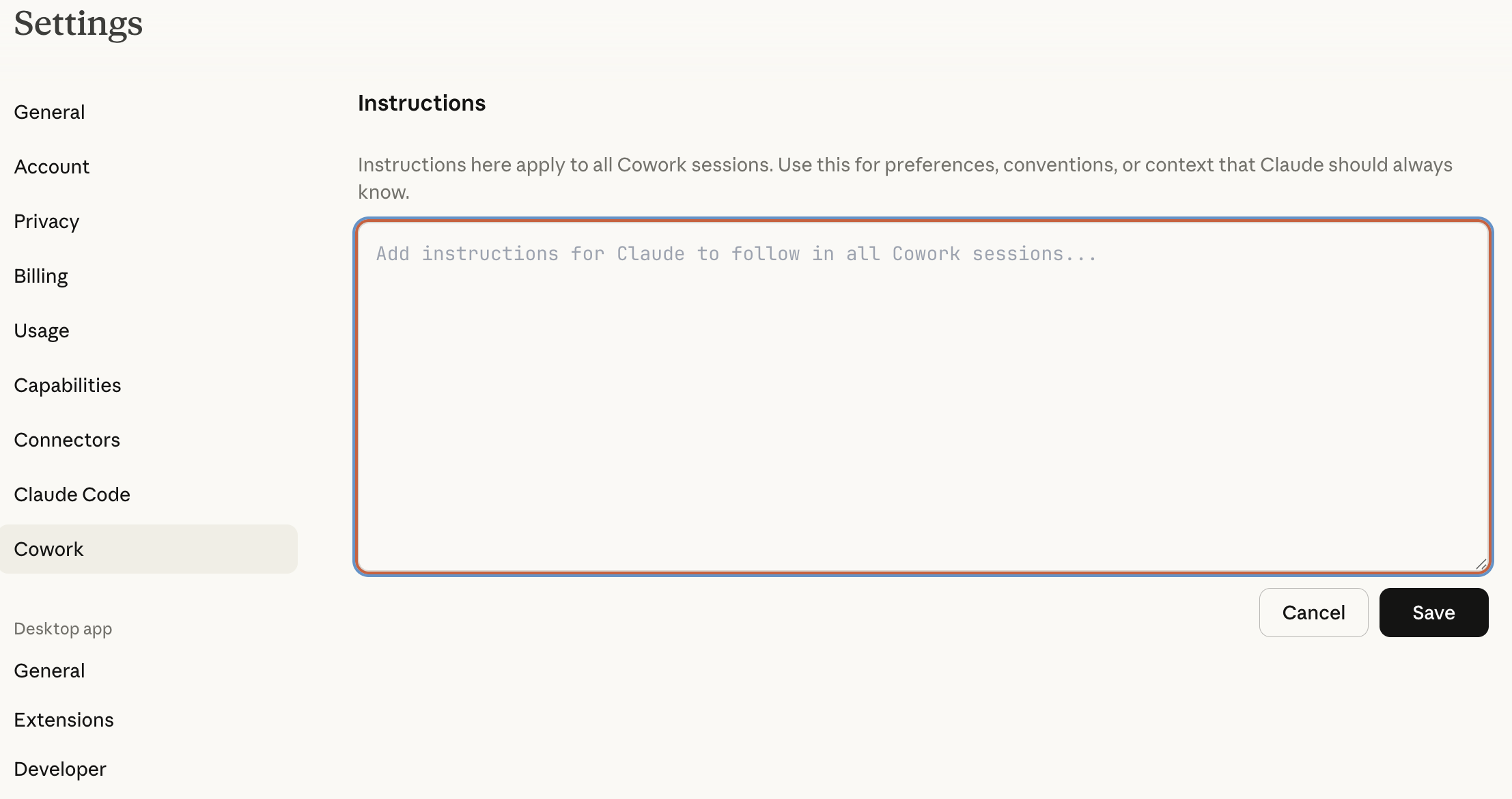
Save this as a folder instruction for this project: This is a [GENRE] novel. Always read Outline/SYNOPSIS_v1.md before acting on any chapter. Do not delete existing character or worldbuilding details.Claude can create and update folder instructions on its own during any session. For global preferences that apply across all Cowork sessions (your preferred tone, output format, role background), navigate to Settings > Cowork and click “Edit” next to Global Instructions.
Which fiction tasks should you delegate (and which should you keep)?
Not every part of writing benefits from delegation. The tasks worth handing to Cowork share a common trait: they require reading across many files and producing structured output. The tasks worth keeping are the ones that define your voice, your story sense, and your creative judgment.
Delegate these:
Continuity checking across chapters (character ages, timeline consistency, location details, backstory references)
Developmental editing passes that flag pacing, structure, and emotional-beat problems across the full manuscript
Series bible generation and updates from existing chapter content
Outline expansion from rough notes to detailed, chapter-level breakdowns with scene goals and turning points
Targeted line-editing passes (”tighten over-explaining,” “reduce dialogue attribution,” “sharpen sensory detail”) across all chapter files in one run
Keep these:
Voice mode your ideas, desired direction, important plot points, etc. The story is yours, not Claude’s.
First-draft prose where voice and instinct matter most
Story decisions: which scenes to cut, which characters to kill, which endings to choose
Emotional calibration: the feel of a scene is still a human judgment call
The final draft
Cowork handles the structural, analytical, and cross-referential work. You handle the creative decisions and the final prose. This is the same division of labor that exists between an author and a skilled developmental editor. This is how James Patterson does it with co-writers.
Which story framework should you feed Cowork?
A good outline needs a spine. The prompts in this issue reference “three-act structure” because it is the lowest common denominator. But the outline Cowork generates will improve dramatically if you specify which story framework to use. The framework you choose shapes how Cowork distributes beats, sequences turning points, and tracks your character’s internal arc.
Here are six frameworks worth knowing, and when each one fits best:
Save the Cat (Jessica Brody’s novel adaptation). 15 beats mapped to percentage markers across three acts. Best for: commercial fiction where precise pacing matters. Strongest feature: it names specific structural moments (Catalyst at 10%, Midpoint at 50%, All Is Lost at 75%) that give Cowork concrete targets when generating chapter outlines. Originally developed by Blake Snyder for screenwriting, Brody adapted the framework for longform fiction.
The Story Grid (Shawn Coyne). Analyzes scenes through value shifts (positive to negative polarity) and tracks genre-specific obligatory scenes and conventions. Best for: revision and developmental editing, especially when you suspect scenes lack movement. Cowork’s dev-edit pass (Prompt 4) becomes significantly more precise when you tell it to flag missing obligatory scenes for your content genre. [Coyne, 2015]
Dan Harmon’s Story Circle. Eight steps arranged in a circle: You, Need, Go, Search, Find, Take, Return, Change. A simplified Hero’s Journey focused on character transformation. Best for: character-driven fiction, short stories, and writers who find the Hero’s Journey too complex. The circular structure also works well for episodic series where each book follows a similar arc.
The Snowflake Method (Randy Ingermanson). Starts with a single sentence and expands fractally through ten steps into a full outline with character worksheets and scene lists. Best for: writers who need to develop both plot and characters simultaneously. Pairs well with Cowork because each expansion step produces a discrete file that Cowork can iterate on.
The Hero’s Journey (Joseph Campbell / Christopher Vogler). 12 stages (Vogler’s streamlined version) tracking the protagonist from Ordinary World through the Ordeal and back. Best for: fantasy, science fiction, and mythic storytelling. The archetypal stages give Cowork strong structural anchors for worldbuilding-heavy genres.
Seven-Point Story Structure (Dan Wells). Hook, Plot Turn 1, Pinch Point 1, Midpoint, Pinch Point 2, Plot Turn 2, Resolution. Best for: thriller and suspense writers who need precise tension management. The pinch points create natural moments of pressure that translate directly into chapter-ending hooks.
When you run Prompt 2 (outline generation), add a single line to the instructions specifying your framework. For example: “Structure this outline using Save the Cat’s 15 beats, mapped to chapter percentages for a 90,000-word novel.” That one sentence changes the entire output from generic three-act filler to framework-specific precision.
One more thing, and publishers will tell you this is the most important.
Frameworks are the skeleton. Genre conventions are the contract with the reader. Every genre has obligatory scenes that readers expect, consciously or not.
Romance requires a meet-cute, a first kiss, a breakup, and a reconciliation.
Thrillers need an escalating threat and a ticking clock.
Mystery demands a crime, red herrings, clues the reader can follow, and a revelation that reframes everything.
Coyne’s Story Grid maps these conventions by genre in detail.
Before you outline, identify the obligatory scenes for your content genre. Then add them to your Cowork instructions:
Ensure the outline includes these obligatory scenes: [list them].A structurally sound novel that ignores genre conventions is the most common reason manuscripts get rejected.
Related Posts
The Prompts
Scan My Project and Build an Overview
Turn Rough Notes into a Series-Ready Outline
Draft a Chapter from My Outline
Full-Manuscript Developmental Edit
Build a Voice DNA Skill from My Writing
Prompt 1: Scan My Project and Build an Overview
Architecture: B (Structuralist) | Format: XML
